Call for Papers: After the Fold
Contemporary Approaches at the Intersection of Artists ’Books and Experimental Poetics
Previous Image
Overview
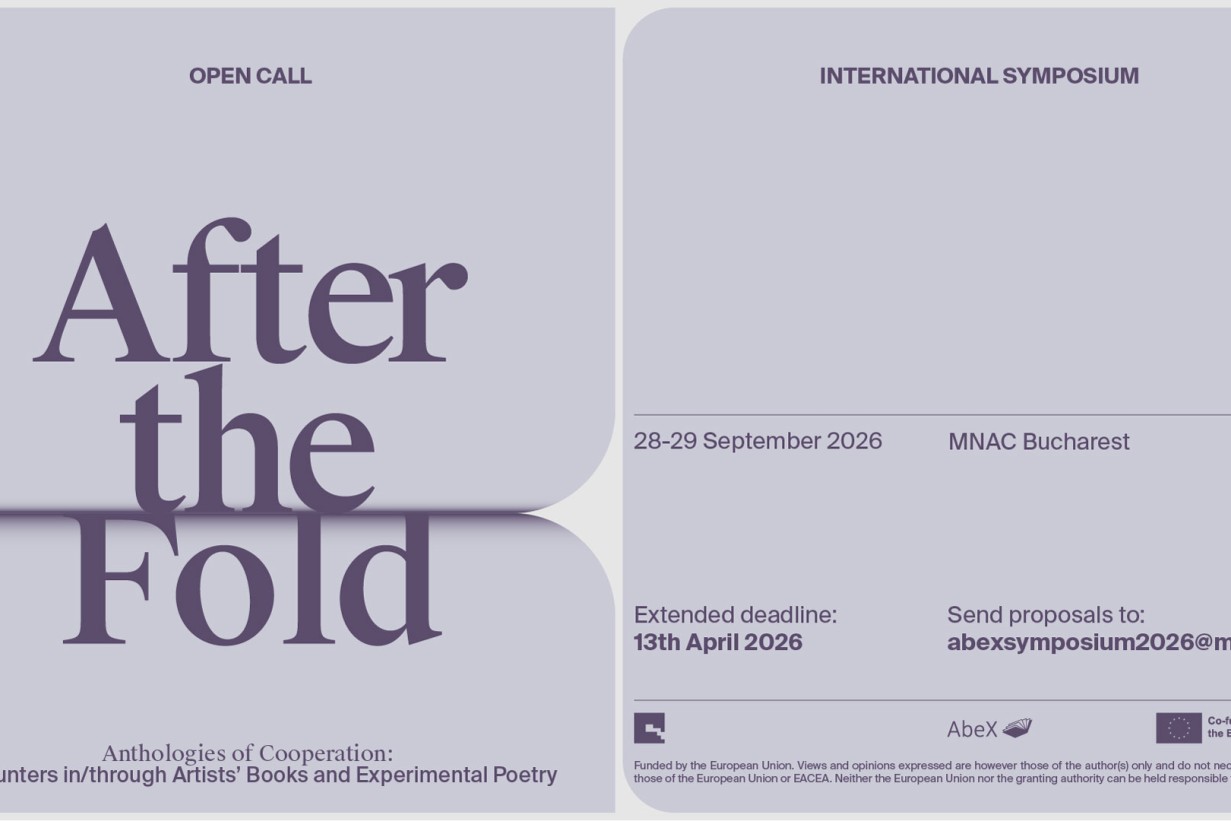
As the concluding event of the AbeX project – “Anthologies of Cooperation: Encounters in/through Artists ’Books and Experimental Poetry” – this symposium brings together scholars, researchers, artists, and poets to explore the intertwined legacies and possible futures of artists ’books and experimental poetry.
Through a polyphony of voices from visual culture, literary practice, and critical theory, After the Fold aims to open an expansive space for theoretical reflection, historical reassessment, and forward-looking experimentation. The symposium will include presentations, performances, artist talks, and workshops alongside opportunities for informal dialogue and live encounters with printed matter and experimental forms.
The fold—whether in a page, a thought, or a form—is both a gesture and a metaphor. In bookmaking, it binds and structures; in poetic or artistic practice, it may rupture, conceal, or transform. What comes after the fold? This symposium asks what unfolds when we move past conventional categories and forms—when artists’ books move beyond objecthood, when poetry turns spatial, performative, illegible, or algorithmic.
Looking at key concerns across theory, practice and transdisciplinary dialogue, the symposium will be organised into four thematic streams, whose aim is to bring to the fore the methodological and conceptual intersections of artists’ books and experimental poetry, as media of “rupture” – of traditional modes of production or presentation/reception –, challenging the formal and material limits, authorship and the book itself.
Through a polyphony of voices from visual culture, literary practice, and critical theory, After the Fold aims to open an expansive space for theoretical reflection, historical reassessment, and forward-looking experimentation. The symposium will include presentations, performances, artist talks, and workshops alongside opportunities for informal dialogue and live encounters with printed matter and experimental forms.
The fold—whether in a page, a thought, or a form—is both a gesture and a metaphor. In bookmaking, it binds and structures; in poetic or artistic practice, it may rupture, conceal, or transform. What comes after the fold? This symposium asks what unfolds when we move past conventional categories and forms—when artists’ books move beyond objecthood, when poetry turns spatial, performative, illegible, or algorithmic.
Looking at key concerns across theory, practice and transdisciplinary dialogue, the symposium will be organised into four thematic streams, whose aim is to bring to the fore the methodological and conceptual intersections of artists’ books and experimental poetry, as media of “rupture” – of traditional modes of production or presentation/reception –, challenging the formal and material limits, authorship and the book itself.
Thematic Streams
1. Methodological Considerations: Historiography, Image-Text Dynamics, Critical Positioning
How do we revisit and rethink the historically entangled production of artists ’books and experimental poetry? What frameworks—historical, discursive, visual, poetic—can account for their hybrid logics?
This stream investigates key historiographical and epistemological models, including Aby Warburg’s Mnemosyne Atlas as a “proto–artist’s book,” and invites contributions that critically reflect on methodologies of seeing, reading, and positioning across visual and literary disciplines.
Possible topics include:
- Working with(in) the big archive: the historiography of artists’ books and experimental poetry
- Iconology, image theory and alternative visual-textual genealogies
- Methodologies of positioning: seeing, reading and mapping after the various turns
- Critical frameworks for analysing the book as a conceptual, performative, or archival form
- Practice-led research, curatorial strategies, and visual essays as modes of knowledge production
2. Artists ’Books: Medium, Context, Circulation
Artists ’books elude easy classification—at once textual and visual, singular and multiple, democratic and esoteric. This stream considers artists ’books through their production and reception across contexts, including censorship, marginality, and digital transformation.
It further examines the artist’s book in relation to institutions (museums, archives), publishing
practices (zines to AI), and current concerns around sustainability, materiality, and authorship.
Possible topics include:
- Artists’ books and political dissent: case studies (i.e. post-communist, marginalised geographies)
- Function of the artist’s book and its place in visual art and conceptual practices: between object, archive, and event
- Artists’ books and the Museum: strategies of collecting, challenges in preservation, curating and mediation
- Publishing practices: from print multiples to digital formats
- From zines to AI: automation and authorship
3. Experimental Poetry: Resistance, Performance, Algorithms
This stream explores experimental poetics as a space of formal innovation and cultural resistance. From illegibility to embodiment, visual poetry to code-writing, how does poetry confront and reimagine its medium, particularly in the age of algorithmic authorship and platform-driven aesthetics?
We also welcome reflections on the ecological and political dimensions of poetic experimentation—including ecopoetry and poetry’s role in environmental critique.
Possible topics include:
- Beyond the avant-garde: towards new genealogies of experimentation
- Poetic practices in the context of generative AI and algorithmic authorship
- Poetics of the Anthropocene, ecopoetry, and environmental resistance
- From page to stage: performativity and embodiment in experimental poetic practice
4. Areas of Intersection: Hybridity, Dialogue, Transdisciplinarity
This stream focuses on convergence: where artists ’books and experimental poetry cohabit and mutate; where hybrid practices defy genre boundaries; and where transdisciplinary collaboration (e.g. with scientists, ecologists, or technologists) enriches both theory and practice.
It also considers the material and ecological dimensions of creative work—publishing’s carbon footprint, sustainable design, and the ethical challenges of digital creation.
Possible topics include:
- Hybrid works between poetry and artists ’books: the book as space, score, map, or ritual
- Artistic and literary responses to generative AI
- Transdisciplinary collaborations (e.g. with environmentalists, coders, geologists)
- Ecological artivism: biodiversity, extractivism, greenwashing
- Sustainable publishing and design practices
- Function of the Artists Book in Visual Art and Poetry: Between Word and Vision
Formats and Contributions
We invite diverse forms of participation:
- Academic papers
- Roundtable contributions and interdisciplinary dialogues
A Scientific Board comprised of experts in the fields of visual culture and literary studies will review and select the final list of participants. Proposals will be assessed for conceptual clarity, relevance to the symposium themes, originality of format, diversity of approach etc.
Submission Guidelines
To apply, please submit the following in English:
- Title of your presentation
- Abstract (max. 500 words)
- Short bio or CV
Timeline & Important Dates
- Extended deadline for submissions: 14 April 2026, end of day CET
- Extended review period: 14–27 April 2026
- Notification of acceptance: extended to 29 April 2026
- Confirmation of participation: extended to 1 June 2026
Partners:
MAK — Austrian Museum for Applied Arts (MAK Österreichisches Museum für Angewandte Kunst), Vienna, AustriaKNP — kultura natura pARTicip, Bihor, România
FMK — the Faculty of Media and Communication, Singidunum University (Univerzitet Singidunum
- Fakultet za medije i komunkacije), Belgrade, Serbia
MNAC — the National Museum of Contemporary Art of Romania (Muzeul Național de Artă
Contemporană al României), Bucharest, Romania
Organiser: MNAC Bucharest
Funded by the European Union. Views and opinions expressed are however those of the author(s) only and do not necessarily reflect those of the European Union or EACEA. Neither the European Union nor the granting authority can be held responsible for them.